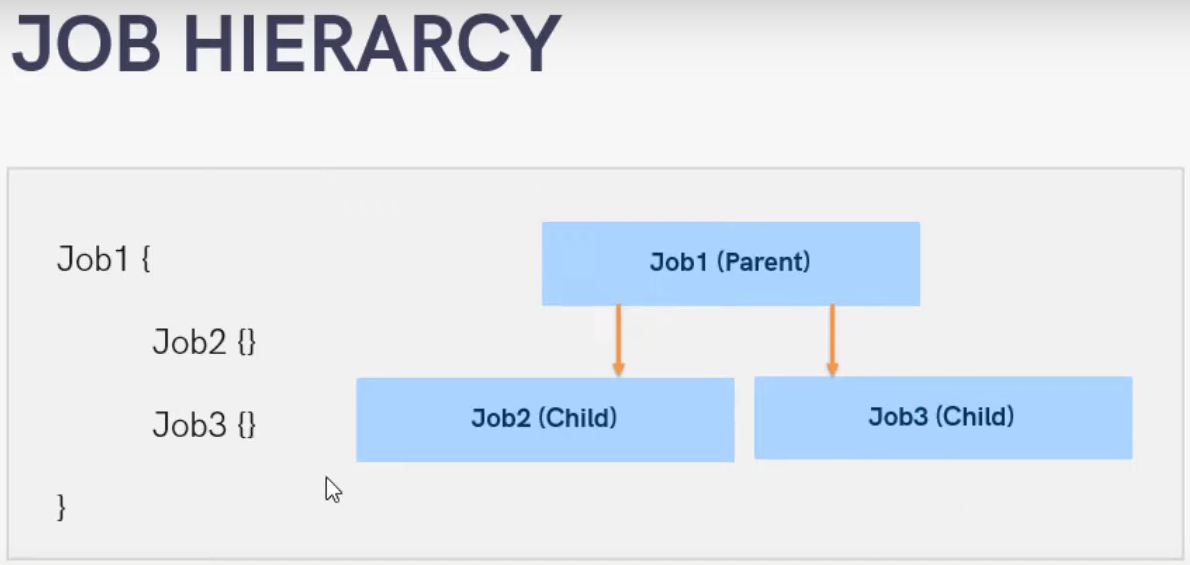
if we cancel the parent job, the child jobs are automatically cancelled
if we want to wait until the parent job is completed, then parent job will wait until the child jobs are completed
Child jobs inherit the parent coroutine context :
val parentJob = launch(Dispatchers.Main) {
println("parentJob scope is $coroutineContext")
val childJob = launch {
println("childJob scope is $coroutineContext")
}
// We can also override the parent coroutine context
val childJob = launch(Dispatchers.IO) {
println("childJob scope is $coroutineContext")
}
}
Scenarios
join parentJob
suspend fun execute() {
val parentJob = launch(Dispatchers.Main) {
println("parentJob started")
val childJob = launch(Dispatchers.IO) {
println("childJob started")
delay(5000)
println("childJob ended")
}
delay(3000)
println("parentJob ended")
}
parentJob.join()
// This method suspends the calling routine until the parentJob is completed
println("parentJob is completed")
}
// Output:
parentJob started
childJob started
parentJob ended
childJob ended
parentJob is completed // parentJob will not be in completed state
// until all the childJobs are completed
cancel parentJob
suspend fun execute() {
val parentJob = launch(Dispatchers.Main) {
println("parentJob started")
val childJob = launch(Dispatchers.IO) {
println("childJob started")
delay(5000)
println("childJob ended")
}
delay(3000)
println("parentJob ended")
}
delay(1000)
parentJob.cancel()
parentJob.join()
println("parentJob is completed")
}
// Output:
parentJob started
childJob started
parentJob is completed
We have cancelled the parentJob and childJob has automatically been cancelled.
cancel childJob
suspend fun execute() {
val parentJob = launch(Dispatchers.Main) {
println("parentJob started")
val childJob = launch(Dispatchers.IO) {
println("childJob started")
delay(5000)
println("childJob ended")
}
delay(3000)
childJob.cancel()
println("childJob cancelled")
println("parentJob ended")
}
parentJob.join()
println("parentJob is completed")
}
// Output:
parentJob started
childJob started
childJob cancelled
parentJob ended
parentJob is completed
What happens under the hood is, when we cancel the childJob, it throws a CancellationException which is caught by the parent coroutine and it cancels the childJob.
suspend fun execute() {
val parentJob = launch(Dispatchers.Main) {
println("parentJob started")
val childJob = launch(Dispatchers.IO) {
try {
println("childJob started")
delay(5000)
println("childJob ended")
} catch (e: CancellationException) {
println("childJob cancelled")
}
}
delay(3000)
childJob.cancel()
println("parentJob ended")
}
parentJob.join()
println("parentJob is completed")
}
// Output:
parentJob started
childJob started
parentJob ended
childJob cancelled
parentJob is completed
cancel a running job
suspend fun execute() {
val parentJob = CoroutineScope(Dispatchers.IO).launch {
for (i in 1..1000) {
longRunningTask()
println(i)
}
}
delay(100)
println("Cancelling Job")
parentJob.cancel()
parentJob.join()
println("parentJob is Completed")
}
fun longRunningTask() {
for (i in 1..10000000) {
}
}
In this case, we are running a long running task in a loop. We are cancelling the job after 100ms.
But actually it will not cancel after 100ms.
What happens is job is in cancelled state, but thread is busy in executing the long running task.
We can solve this issue by checking the isActive property of the coroutine.
suspend fun execute() {
val parentJob = CoroutineScope(Dispatchers.IO).launch {
if (isActive) {
for (i in 1..1000) {
longRunningTask()
println(i)
}
}
}
delay(10)
println("Cancelling Job")
parentJob.cancel()
parentJob.join()
println("parentJob is Completed")
}