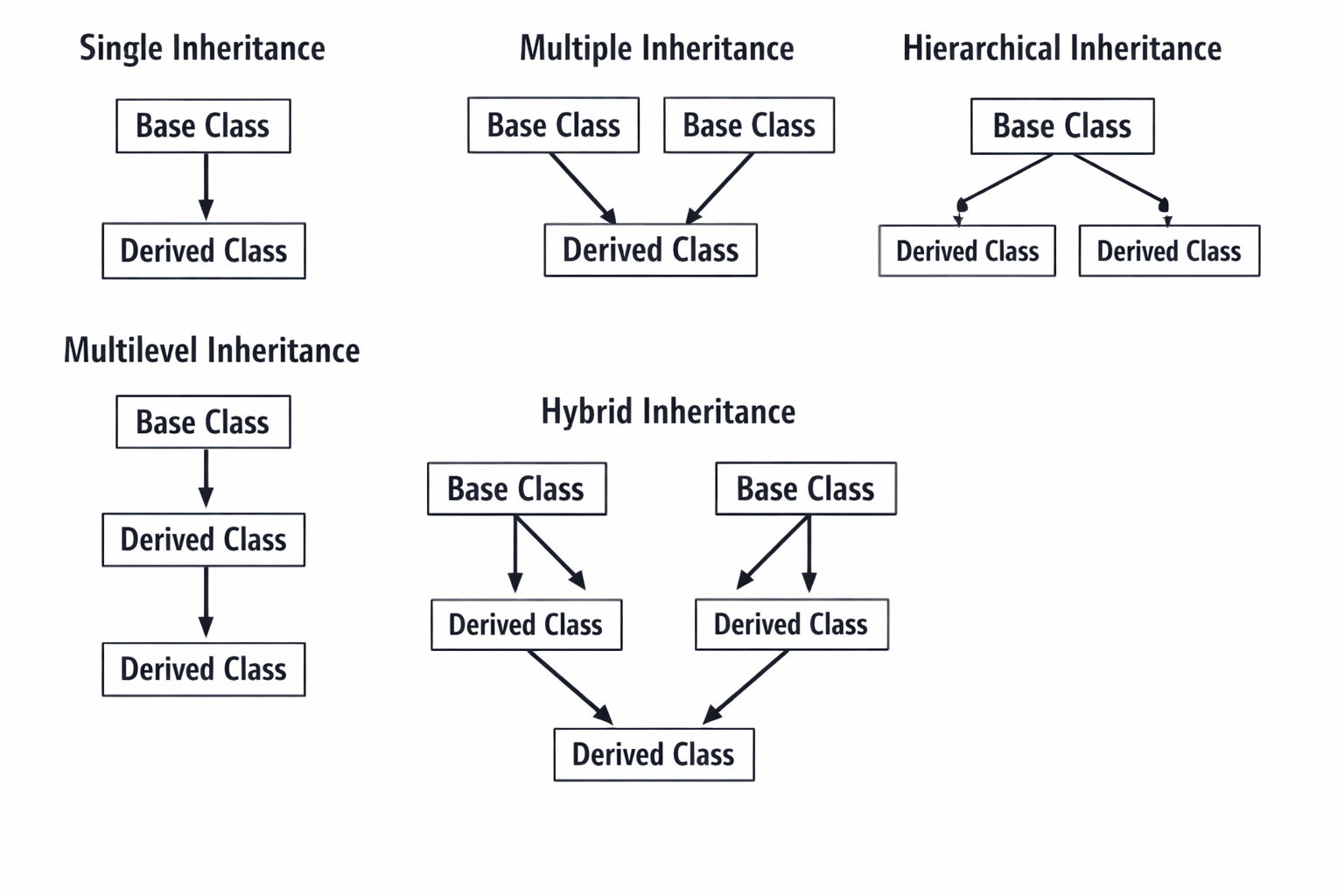
It is the capability of a class to derive properties of another class.
Single Inheritance
class DerivedName : visibilityMode BaseClass {
};
Multiple Inheritance
class DerivedName : visibilityMode1 BaseClass1, visibilityMode2 BaseClass2 {
};
Visibility Mode
It controls the "access specifier to be" for the inheritable members of base class in the derived class.
Inheritance Mode
Base public → Derived
Base protected → Derived
Base private → Derived
public
public
protected
❌ not accessible
protected
protected
protected
❌ not accessible
private
private
private
❌ not accessible
If the inherited members become private in derived class, they cannot be inherited further if the derived class happens to be a base class of another class.
If we specify nothing, the class will inherit privately.
Access Control
A derived class inherits all data members and member functions of the base class as part of its object layout.
This includes private, protected, and public members, and therefore the size of a derived class object includes all base class members, including private ones.
However, the derived class has direct access only to the public and protected members of the base class.
Private members of the base class, although present in the derived object, are accessible only to the base class itself.
Inheritance Example
class Rectangle
{
private:
int length;
int breadth;
public:
Rectangle();
Rectangle(int l, int b);
Rectangle(Rectangle &r);
int getLength() { return length; }
int getBreadth() { return breadth; }
void setLength(int l);
void setBreadth(int b);
int area();
int perimeter();
bool isSquare();
~Rectangle();
};
class Cuboid : public Rectangle
{
private:
int height;
public:
Cuboid(int l = 0, int b = 0, int h = 0) {
setLength(l);
setBreadth(b);
height = h;
}
int getHeight() {
return height;
}
void setHeight(int h) {
height = h;
}
int Volume() {
return getLength() * getBreadth() * height;
}
};
int main() {
Cuboid c1(10, 7, 5);
cout << c1.Volume() << endl;
}
Constructors in Inheritance
When an object of derived class is created, constructor of the base class is called first, and then the constructor of derived class is called.
By default, non parameterized constructor of base class is executed.
Program 1
class Base
{
public:
Base() { cout << "Non-param Base" << endl; }
Base(int x) { cout << "Param of Base " << x << endl; }
};
class Derived : public Base
{
public:
Derived() { cout << "Non-Param Derived" << endl; }
Derived(int y) { cout << "Param of Derived " << y << endl; }
};
int main()
{
Derived d;
}
Output
Non-param Base
Non-param Derived
Program 2
class Base
{
public:
Base() { cout << "Non-param Base" << endl; }
Base(int x) { cout << "Param of Base " << x << endl; }
};
class Derived : public Base
{
public:
Derived() { cout << "Non-Param Derived" << endl; }
Derived(int y) { cout << "Param of Derived " << y << endl; }
};
int main()
{
Derived d(10);
}
Output
Non-param Base
Param of Derived 10
Parameterised constructor of base class must be explicitly called from derived class constructor.
class Base
{
public:
Base() { cout << "Non-param Base" << endl; }
Base(int x) { cout << "Param of Base " << x << endl; }
};
class Derived : public Base
{
public:
Derived() { cout << "Non-Param Derived" << endl; }
Derived(int y) { cout << "Param of Derived " << y << endl; }
Derived(int x, int y) : Base(x) // Calling base class constructor explicitly
{
cout << "Param of Derived " << y << endl;
}
};
int main()
{
Derived d(5, 10);
}
Output
Param of Base 5
Param of Derived 10
Same method name in Derived Class
class Employee
{
int eID;
public:
void printData() {
cout << "eID";
}
};
class Manager: private Employee
{
string title;
public:
void printData() {
cout << "title";
}
void printAllDetails() {
printData(); // "title"
Employee::printData(); // "eID"
// To resolve identity we use scope resolution operator
}
};
Purpose of Inheritance:
Generalization
It is bottom-up approach.
Derived classes already exists, but to simplify things we make a generalized Base class.
We can use a generalized(same) name for different classes : polymorphic
For example, Car - Innova, Swift, Fortuner
We only need to learn How to Drive a car, then we can ride any car we want (Innova, Swift, Fortuner)
Purpose of Generalization is to achieve Polymorphism
Specialization
It is top-down approach.
Derived classes are inherited from already existing base class (More specilized version of base class is made)
It shares it features to its child classes
For example, Rectangle - Cuboid
Cuboid inherits the features of Rectangle.
Purpose of Specialization is to achieve Inheritance